

Jazz: A story for our time
From the March edition of “In A Town This Size,” a monthly column by local writer Steve Williams in The Ogdenite print newspaper.
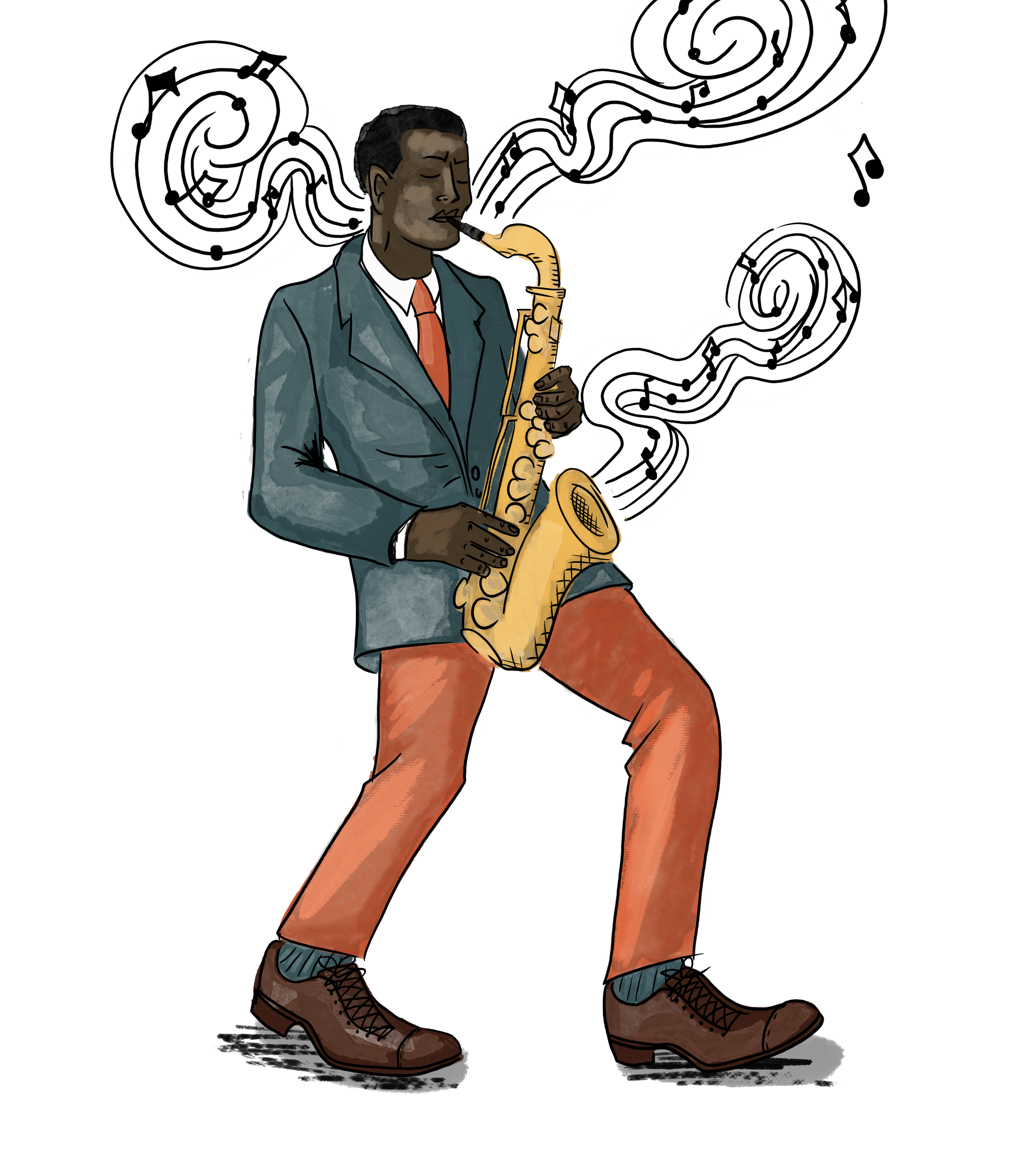
Original artwork by Leon Araujo @noise_explosion
“Life is a lot like jazz. It’s best when you improvise.” – George Gershwin
Lately, I’ve been thinking. One thought I’ve had is that this recent move of mine from Salt Lake to Ogden has held one potential drawback: Where was I going to find regular live jazz? For the past 15 years, the weekly jazz jam at my neighborhood brew pub had become a favorite self-indulgence. Without it, who knows? I could become insufferable, unbearable. Jazz matters a lot to me, you see. I love the music, but there’s also something more going on than taste or preference. Jazz is a way of seeing the world.
Fortunately, there is a small but thriving jazz scene in Ogden. At the corner of 25th Street and Washington Boulevard, on the first floor of the historic Bigelow Hotel, you will find the Two-Bit Bistro. You will also find — on Wednesday and Friday nights — live jazz. On a recent Friday evening, I wandered in with my partner and discovered a young jazz guitarist named Conner Anderson there with his quintet of friends, the New Ogden Jazz Group, playing the standards and taking requests.
“What do you want to hear?”
“Do you know ‘How Insensitive’?”
“I do, but let me check with the band.”
Five minutes later, after a brief band conversation about “keys” and “changes,” Antonio Carlos Jobim’s languid and bittersweet bossa nova started up, its dreamy Chopin-inspired introduction floating up against the copper tiles and across the bar. I had found home again.
If music is a place, jazz is the city.
“The piano,” Thelonius Monk famously said, “ain’t got no wrong notes.” The piano teachers of my childhood were, less famously, not interested in Monk’s musical anarchy, often reminding me that there were, indeed, plenty of wrong notes, and I was playing most of them. It would take many more piano lessons and a couple of decades of living before I began to understand what jazz meant to Monk, what Monk meant to jazz and why any of it even mattered at all.
No wrong notes? Let’s consider that.
My friend Corey, an exceptional jazz guitarist, explains it this way: He says that playing jazz is a series of departures and returns, leaving home and coming back again. The home notes — the ones that fit in comfortably, that sound right — often make up the melody of a song. These are the notes we whistle and hum, and the ones that rocked us to sleep at night when we were young. The notes of leaving — the ones that take us outside and fill us with unsettling emotions, the notes that suggest surprise, fear, apprehension or uncertainty … the so-called wrong notes — these create tension, color and suspense, and they are the ones that often sound out of place, unfamiliar, foreign. Jazz.
Without stretching the analogy too far, let me suggest that jazz offers a remedy for disconnections we feel. Rather than being glossy and predictable, the best jazz succeeds because all the “wrong” notes invite both audience and musician to listen carefully. Jazz anticipates surprises and builds on them. Jazz builds a community that depends on difference because it provides a form where working through those differences in search of harmonic resolution is the point. In the end, Monk was always right — there really are no wrong notes, only notes waiting for the right resolution, the resolution that completes the journey. We could likely all take a lesson.
So when you come down to the Two-Bit on a Friday night, stop and say hello to Connor and his band and ask them for a tune. Find a quiet booth and listen carefully. You might learn a thing or two.
In the meantime, here are five jazz songs to add to your listening:
“Flamenco Sketches” (Miles Davis, “Kind of Blue”)
“The Peacocks” (Branford Marsalis, “Renaissance”)
“Little Sunflower” (Freddie Hubbard, “Backlash”)
“Misty” (Sarah Vaughan, the live version in Sweden)
“Waltz for Debby” (Bill Evans, “Sunday at the Village Vanguard”)

sponsored